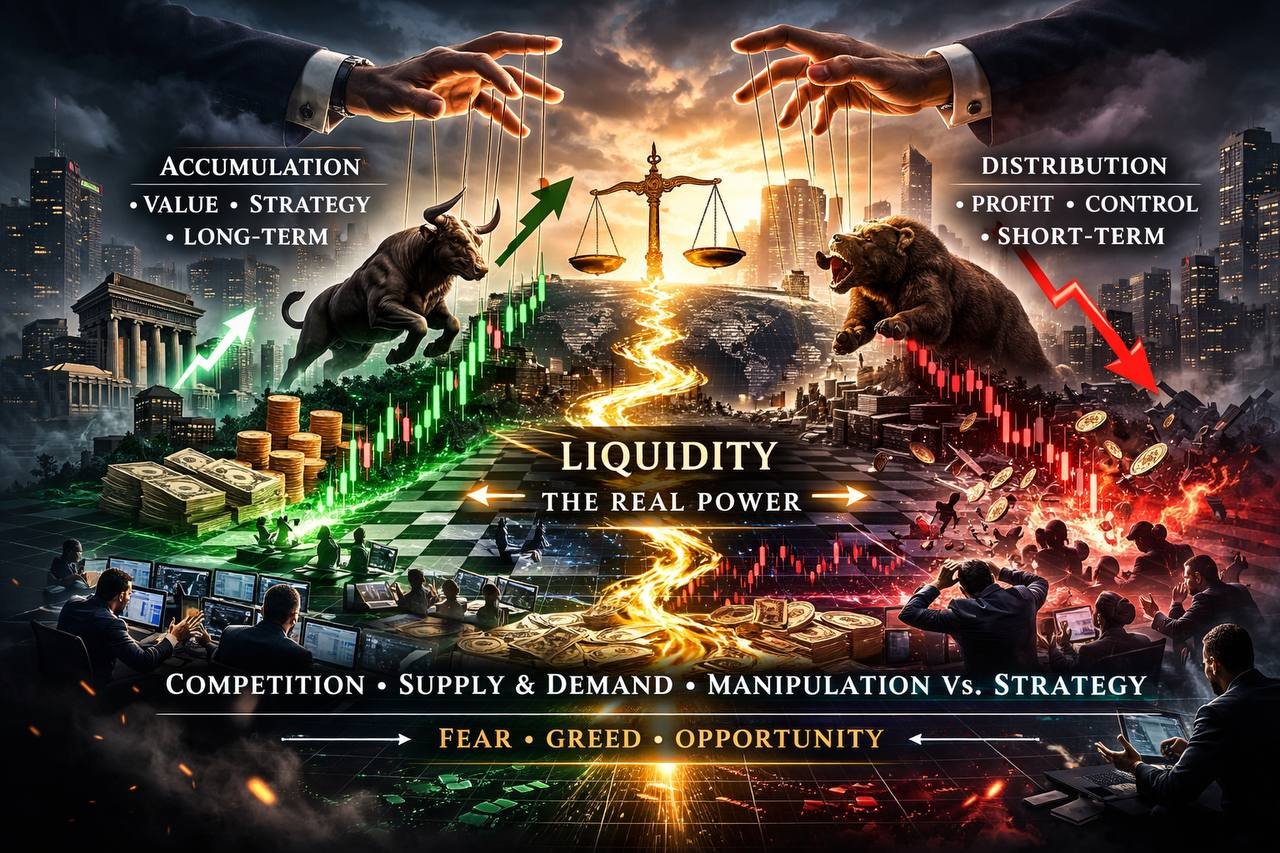
1️⃣ Markets Are Not Emotional. They Are Structural.
Most people describe markets with emotions: fear, greed, panic, euphoria.
But emotions are mostly reactions to what already happened.
Under the surface, markets operate like structural systems.
Price is not a mood. Price is an outcome.
And the strongest driver behind that outcome is liquidity.
2️⃣ Two Layers Operating at the Same Time
A useful way to understand markets is to separate them into two layers:
Layer 1 – Reactive Participants
- Retail traders
- Small liquidity providers
- Short-term momentum followers
They mostly react to price.
Layer 2 – Structural Participants
- Market makers
- Institutional desks
- Large liquidity providers
- Algorithmic traders
They manage liquidity, inventory, and execution.
This is not a moral difference.
It is a functional difference.
3️⃣ What Market Makers Actually Do
Market makers are infrastructure.
They are not “good” or “bad” — they provide the mechanics that allow markets to function.
They typically:
- provide continuous bid/ask quotes
- manage spreads
- absorb order flow
- hedge and rebalance inventory
- optimize execution
This creates stability — until it doesn’t.
Because liquidity provision is also a form of influence:
whoever provides liquidity affects short-term volatility, speed, and price behavior.
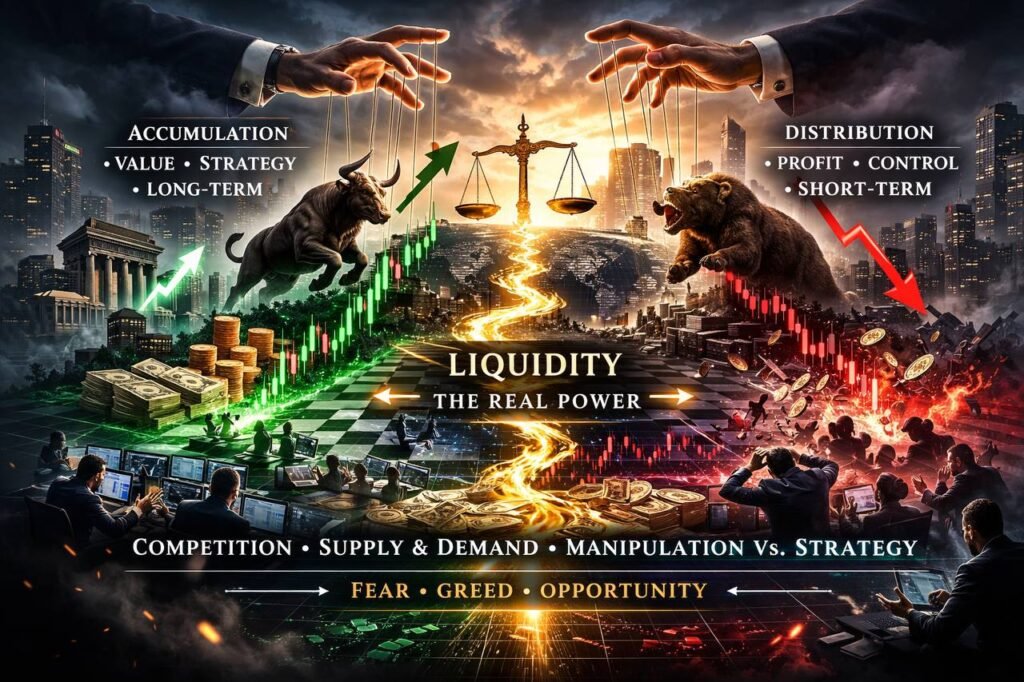
4️⃣ Accumulation and Distribution Are Execution Mechanics
Large capital cannot enter or exit positions instantly without moving the market.
That’s why accumulation often looks like:
- sideways movement
- controlled volatility
- repeated absorption of supply
And distribution often appears as:
- strength into rallies
- selling into enthusiasm
- supply appearing exactly when demand looks strongest
This is not conspiracy.
It is execution reality: big money needs counterparties.
5️⃣ Why Markets Crash
Markets rarely collapse because small traders “decide” to crash them.
Crashes usually come from structural events such as:
- leveraged positions unwinding
- liquidity thinning out
- correlated risk reduction across desks
- forced liquidations and cascading margin events
In many cases, the trigger is not retail activity, but conflict and imbalance among large positions.
Retail often becomes the amplifier:
- chasing tops
- selling fear
- reacting late to structure
When liquidity evaporates, price doesn’t fall smoothly — it gaps.
6️⃣ Competition Among Giants
There is no single “controller” of markets.
Instead, there are competing clusters of capital:
- institutions
- hedge funds
- banks
- quant funds
- large crypto holders (“whales”)
They read each other’s positioning, footprints, and liquidity zones.
Sometimes, one side forces the other side out — not through conspiracy, but through strategy.
And when that competition collides with leverage, the market can destabilize fast.
This is one of the reasons why crashes happen.
7️⃣ The Role of Small Liquidity
Small participants matter — but in a different way than most people think.
Retail and small liquidity often:
- use market orders
- enter late in trends
- place predictable stops
- react emotionally to volatility
Structurally, that behavior becomes liquidity for someone else:
- for accumulation
- for distribution
- for rebalancing
- for hedging
Markets reward preparation and patience.
Urgency usually pays the spread.
8️⃣ The Mature Understanding
A stable, grown-up way to summarize market reality:
- Markets are auction systems.
- Liquidity is the battlefield.
- Capital size creates structural advantages.
- Competition among large actors creates instability.
- Emotion amplifies what structure already started.
This view is not cynical.
It is simply precise.
9️⃣ The One Question That Changes Everything
Before taking any position, ask:
Am I reacting to price —
or am I understanding structure?
Because in the end, the market does not punish belief.
It punishes bad positioning.